Back in grad school, I learned about the instructional triangle, the holy trinity for education.
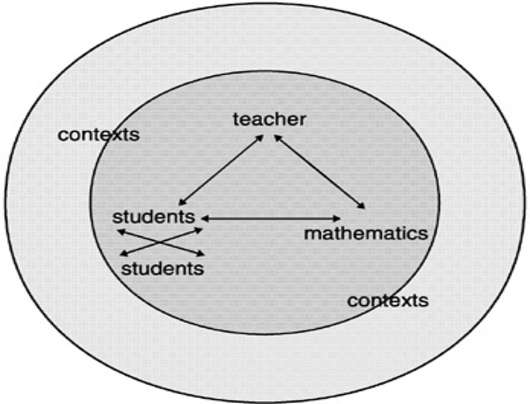
It gives you a way to think about education. The teacher interacts with the students: relationships, routines, classroom management, etc. The teacher interacts with the math content: content knowledge, beliefs about the nature of math, picking out topics to focus on, etc. Then, the students interact with the math: learning math, beliefs about math, prior knowledge, etc. And of course, students interact with each other: student status (I learned this from Lani Horn, so of course status was a constant in our discussions), peer relationships, etc. And all this happens in the context of the school culture, and each student brings their own context of family, culture, etc into the classroom with them. There is a lot unpack here, this is basically all of education.
A few weeks ago, I saw a slightly different version of this same instructional triangle. And my mind was blown.
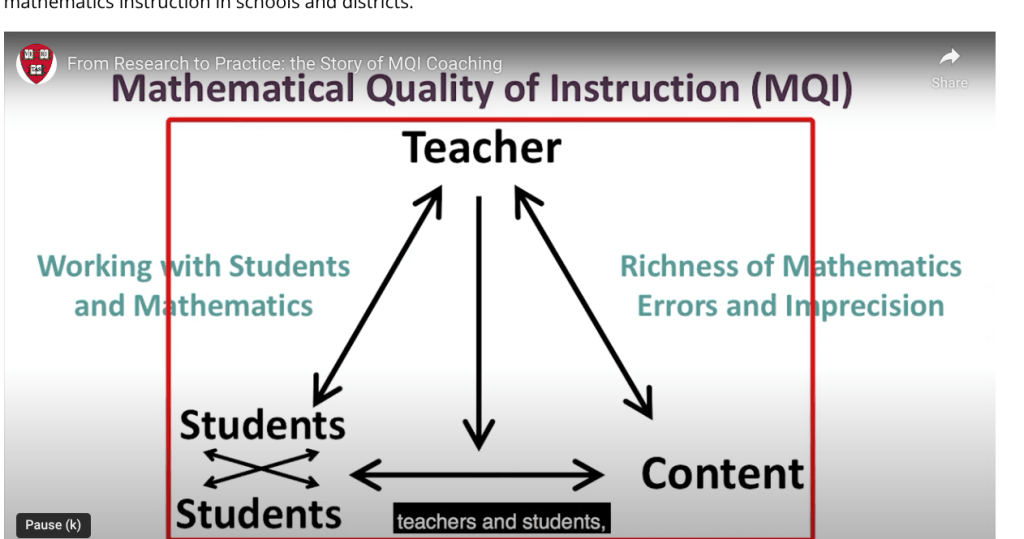
This one comes from a teacher coaching program at Harvard. They claim to have an instructional rubric that is more helpful than most. I wanted to learn the details. What is in the rubric? How do they choose to break down this complex picture of teaching? Of course, they offer almost no details on the web page. Sure, “Richness of Mathematics” matters, but what does that mean?
But while I was searching, watched their video, and they include this picture. It was mostly the same as the one I knew already, but with one little extra line. The one down the middle, the one that points at another line. It’s a relationship, but not between two nodes. It’s the the way that the teacher relates to the students learning math. In other words, this is pedagogy. What effect can the teacher have on student learning? How does the teacher influence student beliefs about math, or the way a student goes about understanding the content? It’s funny, that’s my favorite part of all of education, but I never realized that it was missing from the original instructional triangle.
I was so inspired, I took this picture with me to a PD I was leading the next day. Great conversation flowed!
- What aspects of education live on each edge of the diagram?
- Which edge was the one that inspired you to be a teacher?
- What edge do you have the most to learn about in your practice? Which are you most interested in learning about?
 Open Set
Leave a comment