A little while back, I was doing a Notice/Wonder routine with my 10th grade geometry class. The prompt was a worked example of how to find the volume of a triangular prism. I had a diagram, the formula, the steps worked out. It was something I was about to teach the class how to do later in the period, so it was new to them, and I wanted them to take a solid look at this procedure before we started the lesson.
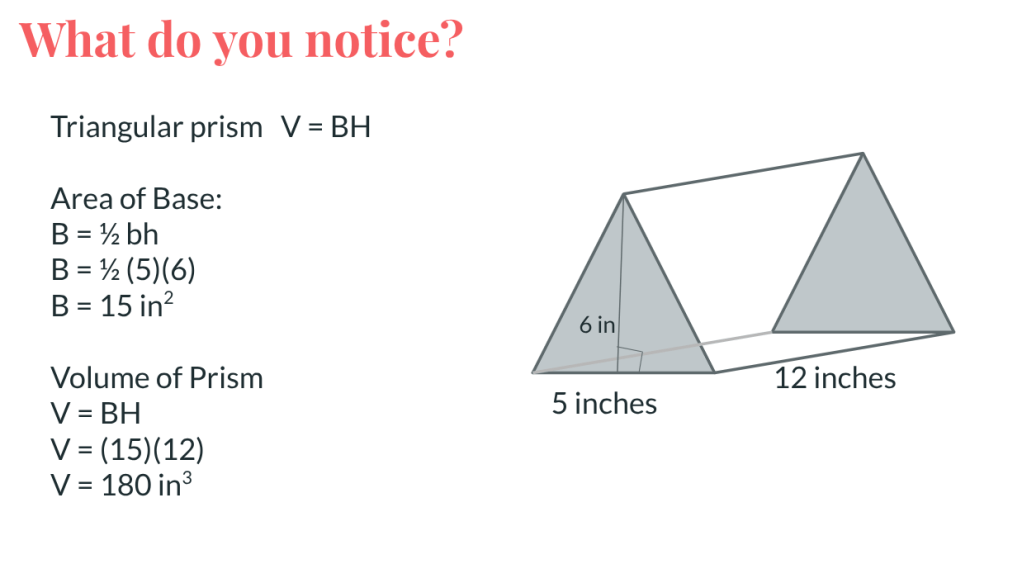
Partway through, one student noticed that there was a lower case b and an upper case B. And then he asked why I had two different types of b’s. My answer was something like, “That’s a great question. Yeah, are they the same, or do they mean something different?” Then I called on the next student. A burst of laughter erupted from the class. “You aren’t going to answer the question!?!” “Can you believe that!” Many of the students were appalled that I would leave a question like that unanswered: what sort of a teacher was I!!
A minute later, that student with the question lets out a loud “Ohhh!” that stops all discussion in the room. He asks to come to the board and explain something. Well that’s a teacher’s dream: please do! He proceeds to give the class a beautiful explanation about the difference between the base of a prism and the base of a triangle. He explains that one is an area, and the other is just a side, and you need b to help calculate B in the first place. It was amazing. He was animated and excited, and his explanation became more clear as it went on. I can only assume that the process of finding words helped him clarify his own understanding.
That lesson was in March, six months into my time with this group. Now it is May. Just last week I had a student snickering because I did not answer a question from her partner. What an awful teacher! And yet, about two minutes after I walked away from that question, I saw the partner excitedly explaining the answer to that question which she figured out on her own.
I think that I’m fairly good at knowing my students, where they are conceptually and what they are ready to figure out. There are many times I do answer questions directly, and many more times that I give hints and prompts. A student lacking patience, confidence, motivation or background knowledge needs something more than a simple, “Keep at it!” But there are other times when the student is inches from figuring it out on their own, and that spark of joy they get from solving the puzzle on their own is an amazing part of math class. I think I have a good sense of when to push and when to support developed over my many years in the classroom.
What I have not yet mastered is how to get students in this class to believe that they can answer their own questions (even though they frequently do). How to get them to realize that math is a thing which could be figured out (even though they frequently do). I’ve tried all the regular methods: talk with them about it explicitly. Solve non-curricular problems together. Use ample group work along with whole-class discussion, and don’t forget turn-and-talks. Somehow, this group is coming from a different place, and I don’t know how to get them over the hump.


Leave a Reply